

What is Claude AI? Definition, how it works, and its applications
Claude AI is an AI assistant developed by Anthropic, designed to answer questions, write content, analyze data, code, handle files, and assist with complex tasks.


Publication date: June 18, 2026

10 minutes
Table of Contents
- What is Claude AI? Simple definition
- Who is behind Claude AI?
- How does Claude AI work?
- What is Claude AI used for?
- Why use Claude AI?
- Is Claude AI French?
- Is Claude AI free?
- What is the difference between ChatGPT and Claude?
- Can Claude AI code?
- Is Claude AI reliable?
- What are the risks with Claude AI?
- Which tool should you use in practice?
- What to remember
What is Claude AI? Key points
- Claude AI is an artificial intelligence assistant developed by Anthropic, an American company specialized in AI.
- Claude can help write, summarize, analyze, code, translate, explain topics and process images or files.
- The tool stands out for its positioning around safety, reasoning, long texts and document analysis.
- Claude offers free access, but some advanced features depend on paid plans such as Pro, Max, Team or Enterprise, depending on the level of use required.
- Like ChatGPT, Perplexity or Grok, Claude AI should be used with caution, especially for sensitive, recent or professional information.
What is Claude AI? This question comes up more and more often as Claude has become one of the main alternatives to ChatGPT. Developed by Anthropic, Claude is an AI assistant capable of answering questions, writing texts, analyzing documents, generating code and supporting reasoning tasks.
But its origin, how it works, its limits and its differences from ChatGPT can still be unclear. In this article, you will discover a simple definition of Claude AI, its concrete use cases, its free or paid access, how it works in English and the precautions to know before using it.
What is Claude AI? Simple definition
Claude AI is a conversational artificial intelligence assistant developed by Anthropic. It lets users ask questions, generate text, analyze information, produce code, process images and help with writing, productivity or thinking tasks.
Anthropic presents Claude as a family of models designed for language, reasoning, analysis, code and professional uses. Recent Claude models are notably organized around the Opus, Sonnet and Haiku ranges, with different balances between power, speed and cost depending on the use case.
In practice, Claude can be used to:
- ask a general question
- summarize a document
- write a text
- structure an idea
- analyze long-form content
- generate or correct code
- translate a passage
- explain a complex topic
- prepare an email
- rewrite a text
Claude therefore belongs to the same family of tools as ChatGPT, Gemini, Perplexity or Grok. Its particularity mainly comes from its positioning: an AI assistant designed for long conversations, document analysis, reasoning and professional uses.
Want to understand the best-known tool before comparing? Our article completes this introduction:
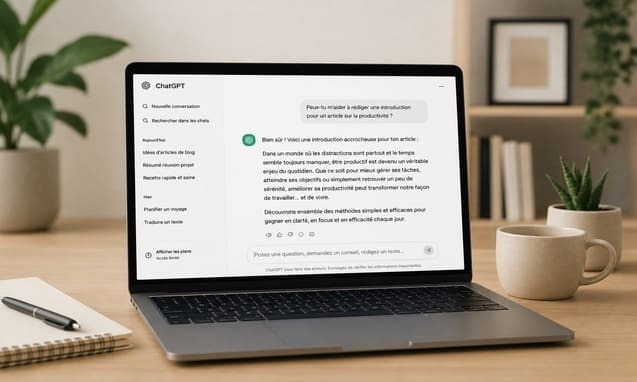
What is ChatGPT? Definition, uses and limits
Publication date: June 11, 2026 I Reading time: 11 minutes 40s
Who is behind Claude AI?
Claude AI is developed by Anthropic, an American artificial intelligence company. Anthropic describes itself as an AI research and safety company, with a goal centered on reliable, interpretable and steerable systems.
This explains a large part of Claude’s positioning. The tool is often associated with ideas such as safety, caution, reliability and limiting dangerous or overly risky responses.
One simple thing should therefore be remembered: Claude AI is not a French product, nor a European AI. It is an American AI assistant, developed by Anthropic, but usable in English and other languages depending on the available access.
Searches such as “Claude AI origin”, “Claude AI creator”, “Claude AI nationality” or “who owns Claude AI” often reflect the same intention: checking who develops the tool before using it. This is a good approach, because the creator of an AI assistant influences how it works, its rules, its plans and its limits.
How does Claude AI work?
Claude AI works thanks to artificial intelligence models developed by Anthropic. The user writes a request, possibly adds a file or an image, then Claude analyzes the intent and generates a response in natural language.
Like other AI assistants, Claude does not understand the world like a human. It produces responses from models trained to process text, code, images, files and instructions. Depending on the model used and the features available, it can also structure data, analyze long documents or help build applications.
The process can be summarized in four steps:
- You write a question or an instruction.
- Claude interprets your request.
- The model uses its language, analysis or reasoning capabilities.
- It generates a response, a text, a summary, code or an explanation.
The quality of the result depends heavily on the precision of your request. A vague instruction will produce a general answer. A clear instruction, with a goal, context and expected format, will almost always produce a more useful result.
To use Claude effectively, give it a role, a goal and a format. For example: “Act as an editorial assistant. Summarize this document in 10 points, then indicate the risks, limits and priority actions.” This structure helps Claude produce a more usable answer.
What is Claude AI used for?
Claude AI is used to write, analyze, summarize, code, explain and structure information. Its main value comes from its ability to handle long or complex requests with a tone that is generally clear and educational.
Claude can be useful for writing an article, rewriting a text, summarizing a PDF, explaining a difficult concept, analyzing notes, preparing a professional response, generating code, correcting a script or comparing several ideas.
For a standard user, Claude is especially useful when raw material needs to be turned into an organized answer. For example, you can give it meeting notes and ask it to create a clear summary with decisions, risks and next actions.
Are you mainly looking to produce publishable texts with AI? Our guide Write a text with AI: simple method and examples to avoid generic content explains how to turn raw generation into more useful content.
Why use Claude AI?
Using Claude AI can be interesting if you are looking for an assistant capable of working on long texts, documents, code or nuanced requests. Claude is often appreciated for its ability to produce structured, cautious and relatively clear responses.
Its value depends on your use case. For long-form writing or analysis, Claude can be very practical. For sourced research with citations, Perplexity may be more suitable. For highly versatile use with a broad tool ecosystem, ChatGPT remains a reference. To produce structured content simply and compare several models from a single interface, Ai-chatpro may be more direct.
Example request for Claude:
“Summarize this document for an executive who only has 3 minutes. Give the 5 key points, the risks, the decisions to make and the questions to ask the team. Answer in clear English, without jargon.”
This type of request uses Claude better than a vague instruction such as “summarize this document”.
Is Claude AI French?
No, Claude AI is not French. Claude is developed by Anthropic, an American company, but the tool can be used in French.
Searches such as “Claude AI in French free”, “Claude Anthropic France” or “is Claude AI French” show a common confusion: the language of use does not correspond to the nationality of the company.
In practice, you can use Claude in French to ask a question, write a text, translate a passage, rewrite a sentence, summarize a document, prepare an email or explain a topic.
The quality of French is generally good, but it depends on the request. For content intended for publication, human proofreading remains essential. Claude can produce a solid base, but you should always adjust the tone, check the facts and remove overly generic wording.
Want to learn how to formulate your requests better in French? Our guide Prompt engineering: a complete guide to understanding and mastering prompts explains how to build more effective instructions.
Is Claude AI free?
Yes, Claude AI offers free access, but with limits. As of the update date of this article, Anthropic presents a Free plan at €0, a Pro plan at about €15 per month with annual billing or about €17 monthly, and a Max plan starting at €85 per month for more intensive use.
Team and Enterprise plans are aimed more at teams and companies. Team is displayed from €17 per seat per month with annual billing, while Enterprise combines a per-seat price with usage costs depending on models and tasks.
In practice, we can distinguish:
- Claude Free, to discover the assistant with limits.
- Claude Pro, to get more capacity and advanced features.
- Claude Max, for more intensive uses.
- Claude Team, for teams.
- Claude Enterprise, for large organizations.
- Claude API, for developers and technical integrations.
You should therefore be careful with queries such as “Claude AI Pro free” or “Claude free unlimited”. Free access may exist, but that does not mean all advanced features are free or that usage is unlimited.
What is the difference between ChatGPT and Claude?
The difference between ChatGPT and Claude mainly comes from their creator, their ecosystem and their positioning. ChatGPT is developed by OpenAI, while Claude is developed by Anthropic.
ChatGPT is often used to write content, create outlines, analyze files, generate ideas, use multimodal tools or work within a very broad ecosystem.
Claude is often used to analyze long documents, produce nuanced responses, work on code, summarize complex content, structure thinking and handle long instructions.
This does not mean Claude is better than ChatGPT, or the other way around. Both tools can meet similar needs. The best option depends on the context: writing, analysis, code, research, productivity, accessibility or work habits.
Would you like to compare Claude with other AI assistants? Our guide Alternatives to ChatGPT: the best AIs to use in 2026 helps you choose according to real use.
If you want to compare Claude with a more research-oriented assistant, our article What is Perplexity? Definition, how it works and differences from ChatGPT is a useful complement.
Can Claude AI code?
Yes, Claude AI can help code, correct code, explain an error or suggest a technical structure. Anthropic strongly highlights Claude’s development capabilities, especially with Claude Code, its tool dedicated to programming tasks and development workflows.
For a developer, Claude can be used to understand an error, generate a function, explain a piece of code, write tests, document a script or refactor part of a project.
However, generated code should always be tested. An AI can produce a solution that looks correct but does not respect the real context of the project, security constraints or internal conventions.
Do you use AI for code? Our guide can complement this approach with a concrete use case:

AI for CSS: how to generate code easily with AI?
Publication date: May 27, 2026 I Reading time: 5 minutes
Is Claude AI reliable?
Claude AI can be useful, but its responses are not automatically reliable. Like all generative AI assistants, it can produce errors, invent information or present a convincing but inaccurate answer.
The main limits are:
- possible factual errors
- misinterpretation of context
- overly general response
- lack of source depending on the use
- possible hallucinations
- dependence on available information
- difficulty with sensitive topics
- need for human verification
Claude is therefore an assistant, not an authority. It can speed up understanding, structure thinking or produce a working base, but important information must be checked.
Claude can give very natural answers, which can increase user trust. However, a fluent answer is not necessarily an accurate answer. For important decisions, you should always compare, verify and consult a reliable source or a qualified professional.
What are the risks with Claude AI?
Like any AI assistant, Claude should be used carefully when sensitive data is involved. Before sharing a document, customer data, medical information, a contract or internal content, it is preferable to check the privacy settings, terms of use and rules that apply to your account.
To compare this caution with another recent assistant, our article What is Grok? Definition, how it works and uses also explains why you should keep some distance from conversational AIs.
Which tool should you use in practice?
The right tool depends on your goal. Claude AI is interesting for testing a serious alternative to ChatGPT, analyzing documents, writing long-form content or getting structured answers. But to quickly produce a text, an email or an article ready to revise, a multi-model platform may be more practical.
Ai-chatpro lets you access several models from a single interface, with no complex installation. You can use it to produce texts, emails, articles or structured content, then compare the results depending on the model used and improve them with your own context.
In practice:
- use Claude to analyze, summarize, code or work on long texts
- use Perplexity to look for sources
- use ChatGPT for general-purpose uses and versatility
- use Ai-chatpro to write, structure, rewrite or compare several models
- always proofread before publication
Try Ai-chatpro
Want to produce a structured text, email or article without switching tools for every use case? Try Ai-chatpro to access several models from a single interface, quickly generate a first draft, then improve it with your examples, tone and proofreading.
What to remember
- Claude AI is an artificial intelligence assistant developed by Anthropic, capable of answering, writing, analyzing, coding, processing files and helping with complex tasks.
- The keyword “what is Claude AI” corresponds to a discovery intent: understanding the tool, how it works, its uses, prices and limits.
- Claude stands out for its positioning around long texts, document analysis, reasoning, code and professional uses.
- Claude offers free access, but some advanced features depend on paid plans such as Pro, Max, Team or Enterprise.
- Like ChatGPT, Perplexity or Grok, Claude should be used with caution, especially for personal data, sensitive topics and information that needs verification.
- Depending on your needs, it can be useful to compare Claude with other models in a multi-model platform such as Ai-chatpro.
What’s the difference between ChatGPT and Claude?
Why choose Claude AI?
Is Claude AI free?
Who’s behind Claude AI?
Try AI Chat Pro now!
Take your projects further with AI Chat Pro and unlock the power of intelligent conversational AI for all your needs.
Articles
- What is Nano Banana?
- What is DeepSeek?
- What is Mistral AI?
- ChatGPT: which one should you choose for your needs?
Categories
Tags